Spirit Families: Gin

Gin is a colorless alcoholic beverage made by distilling or redistilling rye or other grain spirits and adding juniper berries or aromatics such as anise, caraway seeds, or angelica root as flavoring. American Gin is very pure in flavor as effort is made to remove the taste and aroma of the distillates before adding the berries or other flavorants. English gins and Geneva gin are much more influenced by the flavors and aromas of their constituent parts.

When I’m using gin I approach it as a bitter or sour flavor. There’s really no other flavor to use to describe gin. It tastes of juniper berries, plain and simple. Some people describe it as tasting like pine trees but frankly, I don’t taste pine and think they are just repeating what they read elsewhere. I guess that since the juniper is a coniferous plant there may be some hint of it’s parentage to justify the pine tree analogy some like to utilize.

Gin is also one of those alcohols that you either love or hate. Its flavor is so potent that just a little bit goes a long way. I think I’ve been using the same bottle of gin in my bar for the last 10 years, mostly using it a splash at a time.

We’ll examine other families in future posts.

Until then, may all your drinks be tasty. Cheers.

Tasting: Bolton Farm House Old Rum

My oldest friend, Tim, sent me a care package as he downsizes his home bar. He is purging some bottles of which he has multiple and I am the lucky recipient of said excess.

Being the good friend that I am, I had to drink some – you wouldn’t want to disappoint your oldest friend, after all.

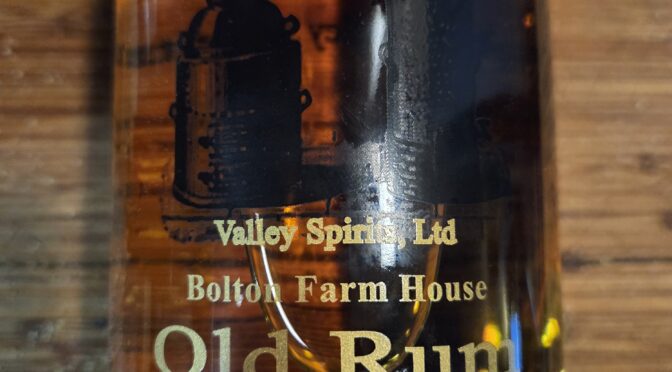
One of the bottles I was gifted with this year was Bolton Farm House Old Rum from Nashoba Valley Spirits. According to their website, they are the first Farmer-Distiller licensed in Massachusetts – that piques my interest and raises expectations.

My first impressions are that it is a very professionally packaged product and pleasing to the eye. I’d consider picking it up for a try just for that reason. I rarely try glitzy, hype filled packaging, I like clean, and functional – to me that means the producer is professional.

LOOK

As I’ve already hinted, the alcohol looks beautiful. A light amber color that allows light to filter though without any hint of additives or unevenness.

In a glass, it exhibits a light body, not clinging to the glass at all. There’s none of the normal warnings that some rums have of added color or boasting of natural flavors (which are normally added after it’s distilled). It’s rum, period.

SMELL

OK, here’s where the large nose is a drawback. This baby packs a punch. The alcohol burn overwhelms the other scents. I could smell a bit of the oaky scent from them aging this for 5 years in charred oak. The average person might not notice and thus fear the alcohol scent but trust me that there is more there.

When later mixed with cola, the harshness, obviously, is taken away and you can slightly smell the oaky scent of the rum.

TASTE

I’m actualy going to talk about 2 tasting attemtps: straight and mixed with some cola (it’s what I had on hand and how I was planning to drink it later, anyway).

Straight: Again, here is where I’m not happy with having more tastebuds than average. This alcohol comes across as harsh. (I’m not saying bad, just very harsh) Now, high proof will do that and this rum is 43% ABV. After shocking my tongue on the first taste, I tried again, holding onto it and rolling it around to find out what was in there. Once I pushed past the alcohol burn I detected an almost caramel undertone. I don’t think there’s caramel color or anything added since the bottle does not mention that so this is probably just a natural flavor from the sugar, et al.

I’m not sure I’d drink this straight. Maybe on a ‘drown your sorrows’ kind of night where you just want a fast kick in the ass.

Mixed: Here is where this rum SHINES! I chose to mix this with the store brand cola (fake Coke) because the whole point of this website is learning to work with what you have, and that’s what I had.

Imagine this scene: Ed taste’s the mixed drink, his lovely wife, Sarah, who is standing nearby asks, “Can I try it?” What does Ed do? Does he hand it to his lady? Nope, not this greedy drinker. I said, “Give me another taste first, I want to be sure of the flavors before you risk it.” I’m such a greedy jerk. 🙂

Anyway (I’m still married after that, BTW), when mixed with cola, the taste is much smoother than straight so I was able to really search out the flavors.

There is a distinct, almost, flowery undertone to the taste. Not sure if that’s just how I’m interpreting the flavor if if there is something in the pre-distillation process that might add that type of flavor.

There’s still the caramel flavor but much more muted. The big one that finally comes through in all its glory is an almost bourbon flavor gained from 5 years in charred oak barrels. It’s still clearly a rum, but that bourbon-esque undertone is wonderful.

AFTERTASTE

I found that both straight and mixed, the rum left a flavor of caramel at the back of my tongue. It doesn’t linger but quickly dissipates, allowing you to set up for the next sip.

VERDICT

I liked it. I’d buy this rum again (providing I’m in an area where it’s carried, since its from MA and I’m in NV).

I recommend, if you have access to this distillery’s products, that you give their products a try. It’s not your mass produced big distillery rum, this is made with love and it shows.

Spirit Families: Neutral Grain Spirit

It’s been a bit busy around the bar the last couple weeks so it’s taken a bit longer to post something but I do have more knowledge to share today. Last time I promised that we would dive into spirit families so here we go.

Also called pure grain alcohol, a neutral grain spirit is a clear, colorless, flammable liquid that is distilled from grain with very high ethanol content (generally 170 to 190 proof). The term neutral refers to the fact that it does not display any flavor derived from the mash used to distill it, nor does it have any flavor added to it after distillation. Grain spirits technically have no taste but add intensity and proof to your drink.

When mixing I use this sort of spirit when I want absolutely nothing but my flavorants to be present. Since this is neutral it does not change the flavors of your fruit or other mixers. However one thing to remember, grain spirits are STRONG. Either use less or dilute with distilled water to a level matching the proof you wish.

We’ll continue examining the spirit families some more next time.

So until then, may your drinks be tasty. Cheers.

Base Alcohols

There may be thousands of brands and variations on themes in the alcohol world but all alcohol on the market comes down to one of eight family groupings. A well stocked bar will contain at least one representative of each family. You may want to possess many of each family to have different brands, quality and variants on hand as well.

Today we’re going to talk about the basics of what an alcohol is and how it’s made (in general, I’m not writing a distiller’s handbook) and later we’ll move on to our favorite ‘families’ of alcohols.

How is alcohol made? Taking things to the most basic level: a water solution, or wash, containing some sort of sugar is created. This liquid is then fermented until all the sugars that can be, are converted to alcohol. At this stage you basically have a form of beer or wine. Now things could stop here and with a tasty beverage to enjoy but our forebears were much more greedy for a happy drunk than that and proceeded to create the process of distillation where the mixture is heated and the alcohol, which has a lower evaporation temperature than the water, separates out of the mix only to be condensed out of the air into another bottle making much stronger alcohol than it was in the base mixture. 

There’s also a technique where the water is frozen out of the mixture which effectively accomplishes the same thing but does have the side effect of leaving impurities and other things in the remaining alcohol.

The raw materials used for making the wash are of two basic types: 

  1. Ingredients containing a high concentration of natural sugars or 
  2. Ingredients containing other carbohydrates that can easily be converted to sugars by enzymes. 

Enzymes are proteins that act as catalysts to promote chemical reactions. Very small amounts of an enzyme can cause a fundamental change in a large amount of material. Most enzymes are specific in their action, so that a system of several enzymes is necessary, for example, to convert starch into sugar and ultimately into ethyl alcohol. The amylases are enzymes that convert starches into sugars; sprouting grains—especially barley—are natural sources of these enzymes. Yeast has a complex enzyme system that converts sugar into carbon dioxide and other products, including ethyl alcohol.

Reduced activity of any enzyme in the system distorts the results, often forming unwanted products. Enzymes are easily poisoned by certain compounds; they are also sensitive to temperature variations and to the degree of acidity of the medium.

Many types of materials are used in the creation of alcohol.

Grapes, cultivated in most of the subtropical and warm temperate zones of the world, are the major fruit employed as the raw material of distilled spirits, and the final product of their fermentation is brandy. Other natural fruits, such as apples and peaches, are used to a lesser extent, and many fruits are limited to local importance.

Sugary vegetables are also used which includes sugarcane, sugar beets, and agave tequilana (a type of cactus). Sugarcane and its products, including cane juices, molasses, and sugar, are the most important of the vegetable group. Grown throughout the tropics and semi tropics, sugarcane is used in making rum and any alcohol derived from rum. Sugarcane juice can be pressed from the cane for use as the base raw material for fermentation, or the juice may be concentrated for sugar production, with the molasses residue from the sugar crystallization used as a base for fermentation. This process is also applied to sugar beets.

Starches are also used. For many centuries, it was only feasible to employ local grain crops for liquor production, and, in this way, the basic characteristics of the local distilled beverage were established. Improved transportation removed this restriction, and today economic considerations frequently determine grain selection, with the principal grain used being the one available at the lowest price per unit of fermentable materials.

Corn is the most important cereal grain employed; it is produced worldwide. Rye grain, though less efficient in fermentation than corn, is used extensively in whiskey production, primarily for the flavor characteristics it imparts to the final product. 

Rice has limited use in distilled spirits production outside of Asia. Barley grain, probably the first cereal employed for distillation in large quantities, was formerly a major crop throughout Ireland and Western Europe. Wheat, because of its high cost, is used only where corn is in short supply and is then limited to production of grain alcohol for blending or in production of liqueurs. Potatoes have been used in distilled spirits production primarily in central Europe; in the tropics, other starchy roots are employed.

Next time we’ll move on to the ‘families’ of base alcohols that contribute to our bar.

Until then, may all your drinks be tasty. Cheers.

Cheap vs Expensive

Let’s talk a bit about the quality of your ingredients.  There’s an old saying: “You get what you pay for.” When it comes to what you put in your mouth it is very true.

When you’re cooking, you need to use the highest quality ingredients to achieve a five star quality meal. When you’re making a cocktail the same concept applies. If you have one underlying ingredient that is cheap and doesn’t balance with everything else, your entire drink may taste at the worst, foul; at the best, slightly off.

Using the highest quality ingredients in all ingredients really does help flavor balance; revealing the trueness of whatever you are creating. 

One more reason to use quality materials: cocktails made with natural ingredients and quality spirits are less likely to attribute to that nasty next day headache. Balance is the key to happiness in everything.

When looking at mixers, many juices and mixes are pure chemical. Now, I’m a thoroughly modern guy who isn’t about to say that all things manufactured are bad, but when you are making drinks you really need to think about what you want for your outcome. Fresh, natural ingredients will give a fuller flavor, better smell and will mix better with whatever you add. When using a mixer made from mostly chemical ingredients you run the risk of adding a chemical aftertaste or a flavor that isn’t true. 

Consider products as ubiquitous as orange juice and orange drink. When looking at them they both register as orange to our eyes. The juice however is a brighter more healthy looking color to your subconscious. It brings to mind orange groves and sunshine. Orange drink while the proper color always looks flat to me. 

Smelling both usually brings radically different reactions. Depending on the quality of the juice you may have a different density of scent but regardless, the fruit smells real to our senses. Orange drink might smell very much like oranges if it’s a high quality drink but for the large bulk of products on the market the scent is usually very chemical in nature, often not even smelling like oranges in the least.

Tasting the juice, regardless of its quality, will flood your mouth with the flavor of real citrus. Acidity spreads the flavor across your mouth and the juice feels cool and refreshing as it goes down your throat. Orange drink on the other hand may deliver a very orange flavor but the subtle secondary tastes are usually missing. You can often taste a metallic chemical undertone that just screams fake to your brain. 

The aftertaste of juice is usually a gentle pleasant tingle of citrus that fades slowly leaving your palate feeling refreshed. Orange drink might provide the same sensations but nine times out of ten the aftertaste is either fleeting or worse, a lingering chemical flavor that fades into an unpleasant metallic residue.

Even alcohol has variations in quality. Filtering can smooth out impurities in the spirits. The methods of aging and even the quality of the manufacturer’s distillation materials and ingredients will affect the taste of the drink. Usually, but not always, more expensive alcohols are higher quality. Face it; you have to pay more for the manufacturer to recoup his costs of quality production. That being said, expensive alcohol is not always better. Sometimes public demand, celebrity endorsements or just uniqueness of the product will drive the price up regardless of its quality. This is where tasting comes into play. I could list every alcohol on the market and give you a rating for it but this would merely be my opinion. Every mixologist must determine what brands they feel to be good as far as their palates are concerned and then stick with those alcohols.

With all that in mind, what would you want to mix with your drink? Would you like to enjoy every sensation of your libation or do you want to be left wanting at the end with an odd undertone of flavor that you can’t quite pinpoint. This type of sensation can mean the difference between someone loving and hating your creation.

Until next time may your drinks always be tasty. Cheers.

Training your tastebuds

Diving right into many types of liquids may be perfectly fine for some people, others may require some up front work to train their taste buds to differentiate flavors. It’s often difficult to take radically different tastes and manage to compare them effectively.

One way to train your taste buds and gain an appreciation for different flavors is to start with a single item that has many varieties.

Even though the focus in this book is on liquids, a solid can be a great training aid and, when dealing with flavored alcohols, it will pay to know the flavors of fruits and other solids.

I used to live in an area that produces a lot of apples, I will use apples as our initial training aid. Buy one each of as many varieties of apples as you can find. If you have a farmer’s market in your area, utilize this source for the freshest apples. If you live in the heart of an urban center, find what you can in your local grocery store. Our goal is to obtain some variety to use as a reference, not an exhaustive supply to learn the wonderful world of apples.

With a notepad in hand, taste slices from each apple variety in succession, making sure to note which is which, and maybe jotting down some thoughts about the flavors that strike you as you go. Treat the apples like the liquids you’ll be categorizing.

Categorize the scent of the cut fruit. Think about how the texture of each feels in your mouth. Focus on how sweet one type of the fruit is in relation with another. If you can start to recognize these types of elements, it will be more of a cinch the next time you face down an unfamiliar liquid taste.

You can follow a similar training regimen with liquids. Do you like coffee or tea? If so, utilize one of these. Gather different coffee or tea flavors and brands. Try different strengths and follow the same methods outlined for apples.

Now here’s where you need to get brave. Organize a comparative tasting of some of the staples in your kitchen.

Don’t shy away from anything. Even if you think it seems odd to try something outside its normal context; you need to expand your taste knowledge and this is a tried and true method.

Here’s some things I want you to consider trying:

  • Oil. (Olive, vegetable etc.)
  • Balsamic vinegar.
  • Various marinades.
  • Worcestershire sauce.
  • Lemon juice.
  • Soy sauce.
  • Mayonnaise and other sandwich condiments.
  • Raid your spice cabinet and taste each spice.
  • Pancake syrup.
  • Chocolate syrup (or any sort of desert topping)

This list might seem odd and not all of it is even liquid but your kitchen is a cornucopia of flavors that should be examined to train your senses to appreciate all the subtle flavors that exist. You might not want to mix a drink with soy sauce but the flavor may come to mind when tasting a new mixer you discover. Your knowledge of the cooking ingredient will allow you to research what types of things soy sauce enhances and use that to translate into choices for your beverage.

You may be surprised at the variation in quality. Everything you taste adds to your knowledge; don’t assume that just because you may never use the item in a drink that its taste is useless to understand. My training rule is: if it’s something you can safely consume—taste and catalog it.

Taste systematically. Start with wide themes to get the big picture, and then narrow your tasting down to try to grasp the finer points. For example try various fruit juices to get a feel for what fruit juices in general are like. Then after gathering a broad spectrum of data, focus on different types of a single juice to learn the nuances of that specific item.

Here’s an example of a couple things that you probably taste every day from my own tasting journal. This should give you an idea of how to proceed with your own tasting and notation.

Diet Cola

  • Look: Dark caramel brown. Light penetrates well but a volume appears nearly opaque. Effervescent. Thin, does not coat the glass.
  • Smell: Light, slightly citrus smell with chemical bite.
  • Taste: Does not coat the tongue. Bubbles provide tingling sensation. Slightly bitter sub taste. A hint of citrus and caramel.
  • Aftertaste: Actually leaves a residue on the back of the tongue. This seems to inspire a desire for more liquid. Probably some of the chemicals used as preservatives.

Whole Milk

  • Look: Opaque white, will color well, creamy; frothy when agitated.
  • Smell: Oddly, it has a slight sour scent
  • Taste: Relatively thin, creamy, slightly chalk-like, and mildly sweet with a hint of sour.
  • Aftertaste: Short lived sweet followed by dull faint sour sensation.

That’s all for today. Until next time, may all your drinks be tasty. Cheers.

Alcohol in history

Alcohol has been around about as long as civilization. The discovery of late Stone Age beer jugs has established the fact that purposely fermented beverages existed at least as early as circa 10,000 BC.

The earliest alcoholic beverages may have been made from berries or honey. Those items remain prevalent in alcohol even today.

The Rigveda (8.48.3, tr. Griffith) states,

We have drunk Soma and become immortal; we have attained the light, the Gods discovered.”

That’s a pretty serious incentive for wanting to drink.

Most of history is filled with accounts of beer and wine or other fermented beverages. Other books you may find in the bartending section of the bookstore have already supplied a mind numbing, boring account of the chronology of drink. Let’s just skip over the Babylonians, Egyptians, and even the Chinese contributions to fermentation and jump right up to what we’ve all come here to talk about—distilled beverages.

Humans have always been inventive with their beverages. Even in the days of the rule of beer and wine, alcohol was drunk in many ways: warm and chilled, pure and diluted with water, plain and spiced. People like tasty things and don’t want to keep drinking the same old thing over and over.

The first clear evidence of distillation comes from Greek alchemists working in Alexandria in the 1st century C.E. Wise men in the Arab world learned the process from the Egyptians and used it extensively in their alchemical experiments. Quite a few medicinal combinations inspire our flavored alcohols. While the Greeks and Arabs gave us the tools and techniques, they didn’t provide the wondrous drink that distillation produces today.

In 1500, German alchemist Hieronymus Braunschweig published Liber de arte destillandi (The Book of the Art of Distillation) the first book solely dedicated to the subject of distillation.

Names like “life water” have continued to be the inspiration for the names of several types of beverages.

Even the Catholic Church considered alcohol as a gift of God, created to be used in moderation for pleasure, enjoyment and health; drunkenness was viewed as a sin, not imbibing itself.

Spirit drinking was still largely for medicinal purposes throughout most of the 16th century. It has been said of distilled alcohol that “the sixteenth century created it; the seventeenth century consolidated it; and the eighteenth popularized it.”

As you can see, as a species we’ve been making alcoholic beverages for quite a good portion of our history. Something this widespread can’t be all bad. Alcoholic beverages have been used throughout history for pleasure, nutrition, medicine, ritual, remuneration and funerary purposes.

Reflecting its vital role, consumption of alcohol in moderation has rarely been questioned throughout most of recorded time. Excessive use and abuse of alcohol is no laughing matter though. Even the great sages of history understood that moderation was king.

In the words of the founding Director of the National Institute on Alcohol Abuse and Alcoholism, “… alcohol has existed longer than all human memory. It has outlived generations, nations, epochs and ages. It is a part of us, and that is fortunate indeed. For although alcohol will always be the master of some, for most of us it will continue to be the servant of man.” (Dr. Morris Chafetz, 1965).

Don’t fret that there might be negative moral consequences of drink – the drink is not evil, only our abuse of it is. Experiment, share and enjoy this gift of the Gods.

Until next time, may all your drinks be tasty. Cheers.

The process – Cleanse the Palate

After you finish tasting, it is important to ‘cleanse the palate’, remove any lingering flavors before proceeding with other tasting. Failure to do so may result in inaccurate sensations or a combination of flavors that will fool you into believing the wrong thing about what was tasted. The most common way to cleanse the palate is to drink a small amount of water or eat a few unflavored crackers.

Different theories exist regarding the need to cleanse the palate. Some say it should only be done when the palate is fatigued to revive your sense of taste, others say to do it after every item. I fall into the second category. A mouthful of room temperature water helps to remove prior flavors and avoid confusion. It also refreshes your mouth surfaces from overly sweet or astringent items providing a fresh canvas upon which to perform further tasting. Most especially after tasting a heavy bodied or syrupy liquid it is very important to clear the mouth of lingering fluids.

One trick I use between tasting that works for me but may not be for everyone is to pull my tongue across the edges of the top teeth. This scrapes residue from the tongue, stimulates the nerves to wake them up and generally helps me ignore the prior flavors. I then rinse my mouth with room temperature water to complete the cleansing. As I said, this isn’t for everyone as some may find it disagreeable or even painful to scrape the tongue on the teeth but it is one more idea for your tasting arsenal. Try it; if you don’t like it, don’t do it again, just stick with water and crackers.

Until next time, may all your drinks be tasty. Cheers.

The process – Compare

This is why you take notes. Compare your sensations and judgments of the item under observation to other things you’ve tasted. Do you see other items that have similar qualities or even contrary qualities that might make a nice juxtaposition?

Add your thoughts about the comparisons that occur to you in the notes about the liquid for future reference.

You should really examine whatever goes into your mouth. The tasting steps, when followed rigorously, will allow you to gather a database, both physical and in your memory, of the tastes and sensations for many liquids that will assist you in your endeavors of creating drinkable concoctions of infinite variety. Don’t assume that a liquid you’ve tasted every day of your life is well known to you. Familiarity breeds contempt; taste things you drink normally with a new focus.

So what if someone notices you taking notes while you taste something in a restaurant, maybe they’ll think you’re a food critic and give you better service or a free drink.

Until next time, may all your drinks be tasty. Cheers.

The process – Notate

Write down the impressions of what you just examined. As we’ve seen, there are a lot of impressions you are gathering while performing the first four steps. Do not rely upon memory to keep things straight, especially in the learning phase. There will come a point where your taste memory can quickly remind you of a specific liquid and how it will mix with something but in your early efforts it is recommended to have a notebook.

In fact, the Notate phase should be performed in tandem with all phases of tasting. It is better to jot down your sensations and observations as they occur rather than try to remember the exact sensations several minutes later after you have been bombarded with flavor, scent and feel.

Buy a bound notebook, not something from which you’ll easily lose the pages. Write down everything you taste that could possibly help you in your endeavors. Note the name of the item, the sensations you receive while tasting, comments about its smell and appearance. Did you try it warm or cold or possibly at varied temperatures.

Make an effort to write down at least the two most outstanding characteristics of Look, Smell, Taste and Aftertaste of the liquid. The more detail you can notate the better but two will at least give you a starting place to begin comparisons to other liquids.

At a minimum, notate which of the basic tastes the item triggers. There may be multiple tastes in more complex liquids; you should pay attention to all of the tastes but especially the dominant one.

It also is useful to write down the strengths of flavors and alcohols so you can know if you will want to use it to bump up your drink or help tone it down.

Until next time, may all your drinks be tasty. Cheers.