Tastes of Terror – October 3

If you want to read the book and tales of terror that these drinks pair with, go HERE. It’s only $1 for the ebook.

October 3rd – Blue Ghost

This is a pretty drink with a bright blue color that’s light on the palate. To
really jazz up the presentation, obtain a blue glow stick, activate it and use it
as a swizzle stick to add an ethereal glow to your drink.
You can also impale a marshmallow on the glow stick as a ghost.

Taste profile: sour, balanced by sweet

Ingredients:
– 2 parts Vodka
– 1 part lime juice
– 1 part Blue Curacao
– 4 parts Sprite™ or 7up™ or other lemon lime soda.

Pour the vodka, lime and Curacao into a shaker with ice. Shake like your
life depends on it. Add to your glass and fil with the soda

If you would like to buy the book with all these recipes AND a horror story to go with each, you can get it from HERE in ebook form for only $1.

Tastes of Terror – October 2

If you want to read the book and tales of terror that these drinks pair with, go HERE. It’s only $1 for the ebook.

OCTOBER 2: BLOOD COCKTAIL

While not the brilliant red that many use to make a blood drink, this
cocktail presents a dark, coagulating blood color that will cause your
vampire friends to salivate.
Begin by creating the blood to coat the inside of the glass. This drink
provides the best presentation if the glass is tall to allow the dripping blood
to be visible above the level of the cocktail.
Taste Profile: astringent, balanced by sweet juice and rum. The whiskey
may be sweet or bitter depending on the style and brand chosen.

Making the Blood:
· 1 cup corn syrup
· 10 drops red food coloring
· 2 tablespoons vanilla extract
This makes much more blood than you’ll need for one drink but who
can drink just one? Drizzle the blood around the rim of your glass (turning
the glass sideways will allow you to drip the blood just inside the rim and
then rotate the glass to cover the entire rim). Allow the blood to ooze down
the inside before adding alcohol. Be careful not to get the blood on the
outside of the glass otherwise you’ll have a sticky mess that no one will
want to hold.

Cocktail Ingredients:
· 3 parts cranberry juice
· 1 ½ parts apple juice
· 1 ½ parts grape juice
· 1 part dark rum
· 1 part whiskey
· 1 part cola


In an ice filled shaker, combine all the ingredients except the cola and
shake until the blood chills and screams for release. Pour gently into the coated
glass then add the cola

If you would like to buy the book with all these recipes AND a horror story to go with each, you can get it from HERE in ebook form for only $1.

Tastes of Terror – October 1

Around the time I wrote A Taste for Drink I also put together a book of short horror stories and drinks to go with them called 31 Tastes of Terror .

31 Tastes of Terror cover.

I love Halloween and even though it’s still over a month away, I’m going to start sharing my October drinks from that book. Here’s the one for October 1st.

If you want to read the book and tales of terror that these drinks pair with, go HERE. It’s only $1 for the ebook.

October 1: Howling Banshee

This drink makes for a wonderful presentation. Depending on the color of the sweet & sour mix, you may achieve more blue or green as the overall color. If presented in a martini glass, the sugar rimmed glass makes this drink perfect for a high-class party.

Taste profile: mostly sweet with a touch of sour to tone it down.

Ingredients:

  • 2 parts rum
  • 1 part Blue Curacao
  • 1 part sweet & sour mix
  • ½ Tsp black sugar (see directions below)

In a shaker with ice, combine the rum, curacao and sweet & sour mix and shake vigorously.

Moisten the rim of the glass with a wedge of lemon and dip the rim of the glass into the bowl containing the colored sugar. I don’t recommend twisting the glass to coat the rim although some bartenders swear by it, experiment and determine what works best for you. Once the glass is rimmed, strain the drink into the glass.

Making the colored sugar:

  • ½ cup sugar
  • Black food coloring

Place the sugar in a bowl and add several drops of the food coloring. Mix the color into the sugar using a silicone spatula. Continue adding several drops at a time until you achieve a smooth color.

If you would like to buy the book with all these recipes AND a horror story to go with each, you can get it from HERE in ebook form for only $1.

Ice Volcano of the Sheep God – a drink with a story

About 10 years ago, the original ATFD was destroyed in a server crash. I’ve found it on the Wayback machine, but after digging through many pages, this was the only one I managed to recover.

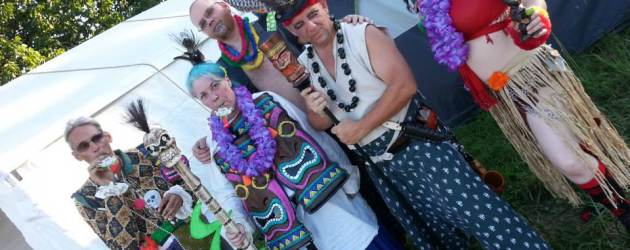
This drink was part of a competition that my entire group entered at an event for the Society for Creative Anachronism called the Pennsic War way back in 2014. And yes, that’s how we dressed for the competition.

Today we present a Tiki drink.

So what makes a Tiki drink?

A cocktail as would have been served in the heyday of “Don the Beachcomber”, “Waikiki Beach”, or “Trader Vic’s” in the 1930′s-1960′s. Elaborate concoctions of Rum and juice with homemade Syrups and Bitters. High Octane and theatrically presented in tiki statues, coconuts, or other outrageous glasses with umbrellas, fruit spears, garlands, garnish, oh, and lest we forget – FIRE.”

On vacation one summer, I entered a Tiki drink competition. My team and I came in third. Not my best showing, but it was a blast. Had lots of compliments on my drink, but I lost because I blew it on my presentation.

Never try a novel, previously untried, method to set a drink on fire when it counts. I flubbed the ignition of my volcano and left the crowd wanting. Although it was fun as hell as we tried over and over to light the drink. Imagine if you will, multiple men and women standing behind your panicking bartender, dancing their hearts out like they’re in an old King Kong movie.

Finally, my lovely wife handed me a cup made of an orange peel and had me use that instead of the ring I was using, and woosh! Fire.

Anywho, here’s the drink. Enjoy it as the perfect summer drink that it is. It will inspire dreams of the islands when Fall covers the land.

Ingredients and construction

First, use a blender to crush ice with 2 parts each of pineapple and either passion fruit or mango juice and 2 parts amber rum. If you can’t make shaved or crushed ice, don’t sweat it, we worked with cubes in the field.

Build in a wide-mouth glass.

Pour the blended frozen mixture into the glass.

Drizzle grenadine and a couple dashes of Pechaud’s bitters on this

Vigorously shake 1 part coconut milk until it’s frothy and float this on the mixture in the glass.

Float 1/2 part black strap rum.

Float an orange peel cup. (trust me, use a cup not a ring, about a 1/3 section of orange skin will make a nice bowl)

Fill the peel with 151 or overproof rum and ignite. Remember to shout: “Volcano – BOOM”

Remember to blow out the flame before you adorn with an umbrella and fruits

Until next time, may all your drinks be tasty. Cheers.

Tastes of Base Alcohols

When mixing I always treat alcohols as these tastes (regardless of what they actually may taste like). Assigning a specific single flavor or category of flavor to your base alcohol allows you to quickly determine how to use it in combination. This is much simpler than trying to make all the subtle subtext of the alcohol match other ingredients; that way leads to madness.

  • Gin, a biting taste, I treat it as a bitter.
  • Vodka is also considered a bitter.
  • Rum is regarded as a sweet.
  • Brandy is also a sweet.
  • Tequila can be classed as bitter or sour.
  • Whiskey can be classified as either bitter, or slightly astringent.
  • Bourbon while a whiskey is considered sweet for our purposes.
  • Vermouth can be sweet or astringent depending upon type.

Until next time, Cheers!

Liqueurs

Liqueurs, also called cordials, are flavored spirits prepared by infusing certain woods, fruits, or flowers, in alcohol, and adding sugar. Some are distilled from specific aromatic or flavoring agents. Cordials and liqueurs are among the most interesting of the spirits as they trace their lineage back hundreds of years, often to medicinal texts of the ancient world.

There may only be eight families of alcohols but liqueurs have a breadth only limited by the imaginations of the producers. While easily able to stand on their own as a sipping libation, they combine wonderfully with base alcohols to make complex cocktails.

Until next time, Cheers!

Spirit Families: Vermouth

A sweet or dry fortified wine flavored with aromatic herbs and used chiefly in mixed drinks. Most producers of vermouth make both Italian style red or sweet vermouth, as well as the French style which is light or dry vermouth. Both are made from white grapes and the color comes from additives.

Treat each type of vermouth separately when categorizing them. I simply use sweet vermouth as a sweet and dry as either an astringent flavor or as if it were a sour.

Spirit Families: Brandy

Brandy is an alcoholic liquor distilled from wine or fermented fruit juice. Cognac is also a brandy but is made from very specific grapes and aged following very strict guidelines creating a very smooth drink. Brandy is complex and open to interpretation much like the wine from which it is made.

Both brandy and cognac are sweet with the hints of the fruits used in their manufacture. It can quickly become overbearing if paired with too many other sweet ingredients.

Until next time, Cheers.

Spirit Families: Tequila

Tequila is an alcoholic liquor distilled from the fermented juice of the Central American century plant agave tequilana. It has a slightly sour taste and the ritual of partaking of salt, then tequila, then lime capitalizes on this flavor perfectly by balancing it with acid and salt.

I normally class tequila as a sour when considering it in a drink. In some ways it reminds me of lemons in the way it interacts with other flavors although it does not actually taste like lemon.

Unless you’re doing a pure tequila drink like a margarita, most people use tequila sparingly. Much like gin, a little goes a long way in the flavor department.

Until next time, may all your drinks be tasty. Cheers!

Spirit Families: Whiskey

Whiskey is distilled from grain, especially in Scotland, Ireland, and the United States. In the United States, whiskey is generally distilled from maize, rye, or wheat, but in Scotland and Ireland it is often made from malted barley. Whiskey has varied forms as Bourbon, Blended Whiskey, Rye, Tennessee, Canadian and Scotch Whiskeys. Entire events are dedicated to tasting whiskeys and aficionados can argue the subtle flavors of their favorite for hours.

The aging process used in whiskey contributes to the flavors. As the spirit sits in its oaken barrel longer, it absorbs more of the flavors of the wood giving it a richer, more complex taste profile.

Some forms of whiskey are sweet such as bourbon while others are more woody, or taste of bitter grains and act as a counter to sweet ingredients. Every whiskey should be considered separately rather than lumping them all together when you catalog them for reference.

Next time we’ll talk about everyone’s favorite margarita maker – tequila.

Until then, may all your drinks be tasty. Cheers.